Walking is one of the simplest ways to stay active, explore your surroundings and get some fresh air.
But if you’ve only got half an hour before work, or an hour free in the afternoon, you might be wondering: How far can you actually walk in that time?
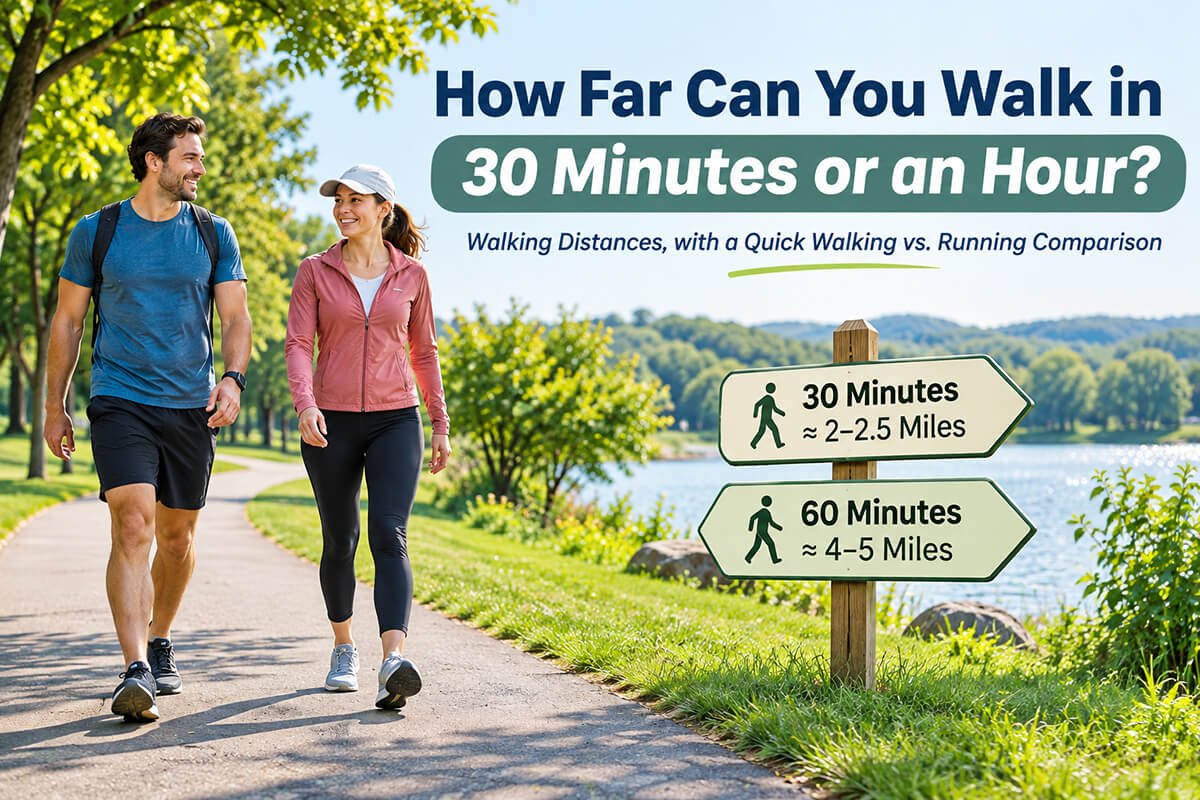
As a general guide, most people can walk around 2-3 km in 30 minutes, or approximately 4-6 km in an hour, depending on their walking speed, fitness and the terrain.
A relaxed walk through a park will usually cover less distance than a brisk walk along a flat road. Hills, traffic lights and stops along the way can also make a difference.
In this guide, we’ll look at how far you can walk in different amounts of time, what affects your walking distance, and how to use Map My Distance to plan a walking route that fits your schedule.
How Far Can You Walk in 30 Minutes?
For most people, a 30-minute walk will cover approximately 2–3 kilometres.
However, the distance depends largely on how fast you’re walking.
Here’s a simple comparison:
| Walking speed | Distance in 30 minutes |
|---|---|
| Slow walk – 3 km/h | 1.5 km |
| Comfortable walk – 4 km/h | 2 km |
| Moderate walk – 5 km/h | 2.5 km |
| Brisk walk – 6 km/h | 3 km |
If you’re walking at a comfortable pace, aiming for around 2 km in 30 minutes is a reasonable starting point.
If you prefer walking quickly, you may be able to cover closer to 3 km in the same time.
These estimates assume you’re walking continuously without long stops.
How Far Can You Walk in an Hour?
If you have a full hour available, you can usually cover around 4–6 km at a comfortable to brisk walking pace.
An hour gives you enough time to explore a local neighbourhood, enjoy a longer walk through a park or complete a planned walking loop.
Here’s how walking speed affects the distance:
| Walking speed | Distance in 1 hour |
|---|---|
| Slow walk – 3 km/h | 3 km |
| Comfortable walk – 4 km/h | 4 km |
| Moderate walk – 5 km/h | 5 km |
| Brisk walk – 6 km/h | 6 km |
A 5 km walk is a useful target for someone who enjoys walking at a moderate pace.
If you’re walking somewhere with steep hills or uneven paths, you may cover less distance while still getting a good workout.
Walking Distance Calculator: How Far Can You Walk in Different Times?
If you want to plan a walk around the amount of time you have available, the table below can help.
It compares estimated walking distances at different speeds.
| Time | Slow (3 km/h) | Moderate (5 km/h) | Brisk (6 km/h) |
|---|---|---|---|
| 15 minutes | 0.75 km | 1.25 km | 1.5 km |
| 30 minutes | 1.5 km | 2.5 km | 3 km |
| 45 minutes | 2.25 km | 3.75 km | 4.5 km |
| 60 minutes | 3 km | 5 km | 6 km |
| 90 minutes | 4.5 km | 7.5 km | 9 km |
| 2 hours | 6 km | 10 km | 12 km |
These are mathematical estimates based on steady walking speeds. Your actual distance may differ due to stops, terrain and changes in pace.
You can use these distances as targets when planning your next walking route.
For example, if you have 45 minutes available and normally walk at around 5 km/h, you could create a route of approximately 3.75 km.
How to Calculate Your Walking Distance
You can estimate how far you’ll walk using a simple formula:
Walking Distance = Walking Speed × Time
The important thing is to use time in hours.
For example, let’s say you walk at 5 km/h for 30 minutes.
Since 30 minutes is half an hour:
5 km/h × 0.5 hours = 2.5 km
If you walk at the same speed for 45 minutes:
5 km/h × 0.75 hours = 3.75 km
This is useful for setting distance goals, but you don’t need to work everything out manually, use MMD to plan it and to export your route GPX or save your walk as an achievement the see what MMD Pro has to offer.
With the Map My Distance Walking Route Planner, you can draw your route directly on a map and see how far it goes.
What Affects How Far You Can Walk?
Not everyone walks at the same speed, and even your own walking pace can change from one day to another.
Several factors can affect how much distance you cover.
1. Your Walking Speed
This is the most obvious factor.
Someone walking slowly at 3 km/h will cover about half the distance of someone walking briskly at 6 km/h over the same amount of time.
Your natural walking speed may also improve as you become more comfortable walking longer distances.
2. Hills and Elevation
Walking uphill usually takes more effort and can slow your pace.
A 5 km route through a flat neighbourhood may take considerably less time than a 5 km walk with several steep climbs.
If you’re planning a route through a hilly area, checking the elevation profile beforehand can help you estimate how difficult the walk might be.
Map My Distance lets you view the elevation of your planned route for free.
3. Terrain and Walking Surface
Walking on a smooth pavement is generally easier than walking along a rocky trail, sandy beach or muddy path.
Uneven surfaces may require shorter steps and more attention, reducing how far you can walk in a given amount of time.
4. Stops Along the Way
If you’re walking around a city, you might stop at traffic lights, crossings or shops.
If you’re travelling, you may stop to take photos, enjoy the scenery or visit attractions.
These breaks can make your total outing longer without increasing your walking distance.
5. Fitness and Experience
Someone who walks regularly may find it easier to maintain a brisk pace for an hour or longer.
If you’re new to walking for exercise, starting with shorter, comfortable routes and gradually increasing your distance is a sensible approach.
How to Plan a 30-Minute or 1-Hour Walking Route
One of the easiest ways to make walking a regular activity is to create routes that fit into your daily schedule.
Instead of deciding where to go while you’re walking, you can plan a route beforehand.
Here’s how to do it with Map My Distance.
Step 1: Decide How Long You Want to Walk
Choose whether you want a 15-minute, 30-minute, 45-minute or 1-hour walk.
You can then estimate your target distance based on your usual walking speed.
For example:
- 30-minute comfortable walk: approximately 2 km
- 30-minute brisk walk: approximately 3 km
- 1-hour moderate walk: approximately 5 km
Step 2: Choose Your Starting Point
Open the Walking Route Planner and search for your starting location.
This could be your home, workplace, local park or somewhere you’re visiting.
Step 3: Draw Your Walking Route
Add points along the roads and paths you want to follow.
MMD calculates the distance as you plan, allowing you to make changes until the route matches your target.
You could create a circular walking route that starts and ends at home, or plan an out-and-back walk along a familiar path.
Step 4: Check the Distance and Elevation
Before heading out, review the total distance and elevation profile.
If the route includes steep hills, you may want to shorten it slightly to stay within your available time.
Step 5: Save Your Favourite Walks
Once you’re happy with your route, save it to your Map My Distance account.
You can build a collection of routes for different amounts of time, making it easy to choose where to walk whenever you have a free moment.
Walking vs Running: How Much Further Can You Go in 30 Minutes?
If you enjoy both walking and running, you might be interested in how the distances compare.
Running generally allows you to cover more distance in the same amount of time, although the difference depends on your pace and fitness.
Here’s an example:
| Activity | Example speed | Distance in 30 minutes |
|---|---|---|
| Comfortable walking | 4 km/h | 2 km |
| Brisk walking | 6 km/h | 3 km |
| Easy jogging | 8 km/h | 4 km |
| Moderate running | 10 km/h | 5 km |
| Faster running | 12 km/h | 6 km |
For example, someone running at 6:00 min/km would cover approximately 5 km in 30 minutes.
Someone walking briskly at 6 km/h would cover approximately 3 km.
Neither activity is automatically better. Walking and running offer different levels of intensity and can both be useful ways to stay active.
If you’re planning a run rather than a walk, you can use the MMD Running Route Planner to create a route that matches your running distance or time goal.
You can also use the Running Pace Calculator to work out how your pace affects your expected running time.
Is Walking for 30 Minutes a Day Enough?
A daily 30-minute walk can be a useful way to build a consistent exercise habit.
If you walk at a moderate pace for 30 minutes on five days each week, that adds up to 150 minutes of activity.
This matches the lower end of the World Health Organization’s general recommendation of 150–300 minutes of moderate-intensity aerobic activity per week for adults.
However, whether your walking counts as moderate-intensity exercise depends on how hard you’re working, not simply the distance you cover.
A slow, relaxed walk may feel very different from a brisk walk that noticeably increases your breathing.
If you’re just getting started, even shorter walks can help you build a routine.
The important thing is to choose an activity level that suits your abilities and maintain consistency.
Should You Walk the Same Route Every Day?
There’s nothing wrong with having a favourite walking route.
In fact, knowing exactly where you’re going can make it easier to fit walking into your schedule.
However, exploring different routes can make your walks more interesting.
You might create:
- A short 2 km route for busy mornings
- A 3 km walk through your neighbourhood
- A 5 km route through a nearby park
- A longer weekend walk with some hills
- A scenic route for walking with friends or family
With Map My Distance, you can save these routes and choose one based on your available time.
You can also share routes with friends or walking groups.
Explore New Places on Foot
Walking isn’t only about fitness.
It’s also a great way to explore a new neighbourhood, discover interesting streets or get to know a place you’re visiting.
If you’re travelling, you can plan a walking route from your accommodation that passes through parks, waterfronts or local attractions.
Measuring the route beforehand helps you understand whether you can comfortably complete it in the time available.
For more ideas, read our guide to How to Plan a Self-Guided Walking Tour When Travelling.
Start Planning Your Next Walk With Map My Distance
Whether you have 15 minutes, half an hour or a full hour available, planning a walking route can help you make the most of your time.
Map My Distance gives you a free online route planner where you can:
- Create custom walking routes
- Measure distances in kilometres or miles
- View elevation profiles
- Plan circular or point-to-point walks
- Save your favourite routes
- Share routes with friends and family
You don’t need a fitness watch to plan and measure a route.
Simply open the map, choose where you want to walk and create a route that matches your distance goal.