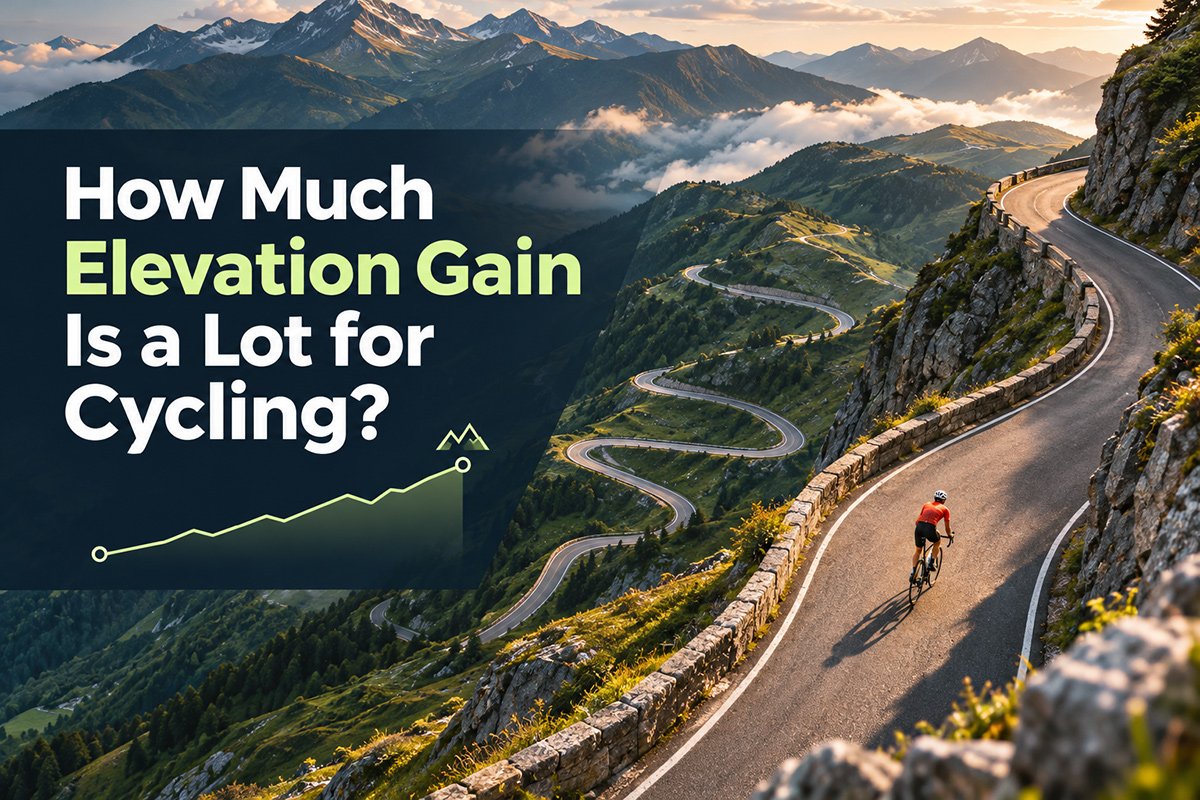
If you’ve ever finished a bike ride feeling much more tired than expected, the hills might have had something to do with it.
When planning a cycling route, most people look at the distance first. But there’s another important number to consider… Elevation gain.
A 50 km ride along relatively flat roads can feel completely different from a 50 km ride with steep climbs and mountain passes.
So, how much elevation gain is a lot for cycling?
As a general guide, 300 – 500 meters of climbing can make a shorter bike ride noticeably hilly, while 1000 meters or more represents a substantial amount of climbing for many recreational cyclists.
However, the difficulty depends on how far you’re cycling, how steep the hills are and your cycling experience.
In this guide, we’ll explain what elevation gain means, compare different amounts of climbing and show how to plan cycling routes with elevation using Map My Distance.
What Is Elevation Gain in Cycling?
Elevation gain is the total amount of uphill climbing you complete during a bike ride.
It’s usually measured in meters or feet.
For example, imagine you cycle up a hill and gain 150 meters of elevation. You then descend into a valley before climbing another hill that gains 200 meters.
Your total elevation gain would be:
150 m + 200 m = 350 meters of elevation gain
The downhill sections don’t cancel out the climbing you’ve already completed.
This is why a cycling route can start and finish at the same elevation but still involve a significant amount of climbing.
Elevation gain is also sometimes called total ascent, vertical gain or simply climbing.
How Much Elevation Gain Is Considered a Lot for Cycling?
The easiest way to judge whether a cycling route is hilly is to look at the elevation gain compared with the total distance.
For example, 500 meters of climbing over 20 km is much more concentrated than 500 meters spread across a 100 km ride.
Here’s a general guide to elevation gain per kilometer.
| Elevation gain per km | General terrain description |
|---|---|
| Under 5 m/km | Relatively flat |
| 5 – 10 m/km | Gently rolling |
| 10 – 15 m/km | Hilly |
| 15 – 20 m/km | Very hilly |
| 20 – 30 m/km | Climbing-intensive |
| Over 30 m/km | Extremely climbing-intensive |
These are illustrative categories, not official cycling difficulty ratings.
The figures describe how much total climbing occurs relative to the entire ride distance. They don’t tell you the gradient of individual hills.
For example, a route with 20 meters of climbing per kilometer could include several rolling hills or one particularly demanding mountain climb.
Your fitness, bicycle, road surface and the length of individual climbs also affect how difficult the ride feels.
Is 300m of Elevation Gain a Lot for Cycling?
For many recreational cyclists, 300 meters of elevation gain is enough to make a ride feel noticeably hilly.
However, the difficulty depends on the distance.
Consider these examples:
- 10 km with 300 m climbing: A very hilly, climbing-intensive ride.
- 30 km with 300 m climbing: A moderately hilly ride.
- 60 km with 300 m climbing: A relatively gentle amount of climbing for the distance.
If you’re new to cycling or normally ride on flat roads, 300 meters of climbing can still be a meaningful challenge.
For experienced cyclists who regularly train in mountainous areas, it may feel relatively manageable.
Is 500m of Elevation Gain a Lot for Cycling?
500 meters of elevation gain is a substantial amount of climbing for many recreational cyclists, especially over shorter distances.
For example:
| Cycling distance | Elevation gain | Climbing per km | General description |
|---|---|---|---|
| 20 km | 500 m | 25 m/km | Climbing-intensive |
| 30 km | 500 m | 16.7 m/km | Very hilly |
| 50 km | 500 m | 10 m/km | Hilly |
| 100 km | 500 m | 5 m/km | Gently rolling overall |
A 20 km ride with 500 meters of climbing could include several steep hills or a sustained uphill section.
By comparison, 500 meters spread across a 100 km route is a much lower concentration of climbing.
The longer ride still requires endurance, but the hills may not dominate the experience in the same way.
For someone preparing for their first hilly cycling event, 500 meters of elevation gain can be a useful training goal.
Is 1000m of Elevation Gain a Lot for Cycling?
Yes. 1,000 meters of elevation gain is a significant amount of climbing, particularly for recreational cyclists.
That’s one vertical kilometer of accumulated uphill riding.
However, it matters whether you complete that climbing over 30 km, 50 km or 100 km.
| Cycling distance | Elevation gain | Climbing per km | General description |
|---|---|---|---|
| 30 km | 1000 m | 33.3 m/km | Extremely climbing-intensive |
| 50 km | 1000 m | 20 m/km | Climbing-intensive |
| 75 km | 1000 m | 13.3 m/km | Hilly |
| 100 km | 1000 m | 10 m/km | Hilly |
| 150 km | 1000 m | 6.7 m/km | Gently rolling overall |
A 50 km cycling route with 1,000 meters of climbing can be a challenging ride, especially if it includes steep gradients.
A 100 km route with the same elevation gain has less climbing per kilometer, although the overall distance makes it an endurance challenge of its own.
The important thing is to consider distance and elevation gain together, rather than judging the ride by either number alone.
Is 2000m of Elevation Gain a Lot for Cycling?
For most recreational cyclists, 2,000 meters of elevation gain is a very demanding amount of climbing.
It’s commonly associated with mountainous cycling routes, challenging events and longer rides that include significant uphill sections.
For example, a 100 km route with 2000 meters of elevation gain averages 20 meters of accumulated climbing per kilometer.
That represents a climbing-intensive route, even if the individual hills aren’t extremely steep.
Completing this amount of climbing comfortably usually requires good endurance, appropriate gearing and experience with longer uphill efforts.
If you’re preparing for an event with 2000 meters of climbing, it’s sensible to gradually build your training rather than attempting the full distance and elevation without preparation.
Cycling Elevation Gain Comparison: 20km, 50km and 100km
Here’s a useful way to compare cycling routes with different amounts of climbing.
| Distance | 200m gain | 500m gain | 1,000m gain | 2,000m gain |
|---|---|---|---|---|
| 20 km | Hilly | Climbing-intensive | Extreme climbing concentration | Extreme climbing concentration |
| 50 km | Relatively flat | Hilly | Climbing-intensive | Extreme climbing concentration |
| 100 km | Relatively flat | Gently rolling | Hilly | Climbing-intensive |
These descriptions compare climbing concentration rather than overall ride difficulty.
A 100 km ride with only 200 meters of climbing may still be physically demanding because of the distance.
Likewise, a 20 km mountain bike ride with 500 meters of elevation gain may be harder than the figures suggest if the trails are technical.
Use the table as a starting point when comparing routes, not as a guaranteed difficulty rating.
Why Gradient Matters as Much as Elevation Gain
Elevation gain tells you how much climbing is involved, but it doesn’t tell you exactly how steep the hills are.
That’s where gradient becomes important.
Gradient measures how quickly the road or trail rises over a horizontal distance.
For example:
- 5% gradient: A noticeable uphill climb.
- 10% gradient: A steep climb for many recreational cyclists.
- 15% gradient: A very demanding uphill section.
- 20% gradient: An extremely steep incline that may be difficult to ride.
Imagine two cycling routes with the same 500 meters of elevation gain.
One route might involve a long, gradual climb at 4 – 5%.
The other might contain several short hills with gradients reaching 15 – 20%.
Both routes have the same total elevation gain, but the steepness and effort required can feel very different.
You can learn more in our guide to Gradient Percentage Explained: How Steep Is 5%, 10% or 20%?.
Does Elevation Gain Affect Cycling Speed?
Of course!
Cycling uphill generally requires quite a bit more effort, and most cyclists or riders slow down as the gradient increases.
The effect depends on several factors:
- Your fitness and cycling experience
- The steepness of the climbs
- Your bicycle and gearing
- Road or trail conditions
- Wind and weather
- The total distance of the ride
For example, a cyclist might comfortably maintain 25 km/h on relatively flat roads but ride considerably slower on a long climb.
Steep hills can also make it harder to maintain a steady cadence, particularly if you’re using gearing that isn’t suited to the terrain.
When estimating how long a cycling route will take, remember that average speed from a flat ride may not be realistic for a route with substantial climbing.
Road Cycling vs Mountain Biking: Does Elevation Gain Feel Different?
The same elevation gain can feel very different depending on the type of cycling.
Road Cycling
Road cyclists usually ride on relatively smooth surfaces, making it easier to maintain a consistent pedalling rhythm.
However, long road climbs can still be extremely demanding, especially when gradients become steep.
Mountain Biking
Mountain bike trails often involve loose surfaces, rocks, roots and technical features.
A 500-meter climb on a mountain bike route may feel more difficult than a similarly long climb on a smooth road because maintaining traction and momentum can require extra effort.
Gravel Cycling
Gravel riding falls somewhere between road cycling and mountain biking.
Long climbs on loose gravel can be challenging, particularly when the road becomes steep or uneven.
This is why it’s important to consider more than just distance and elevation when comparing cycling routes.
How to Check the Elevation Gain of a Cycling Route
One of the easiest ways to prepare for a hilly bike ride is to plan your route beforehand.
With Map My Distance, you can create a cycling route online and view its elevation profile before heading out.
Here’s how to get started.
Open the Cycling Route Planner
Visit the MMD Cycling Route Planner and search for the area where you’d like to ride.
Draw Your Cycling Route
Add points along the roads and paths you want your route to follow.
As you build the route, MMD calculates the total distance.
View the Elevation Profile
Open the elevation profile to see where the route climbs and descends.
This helps you understand whether the ride includes long hills, rolling terrain or relatively flat sections.
Compare Different Route Options
If your route looks too hilly, try adjusting it to include alternative roads or paths.
You can compare the elevation profiles to better understand the climbing involved.
Save & Share Your Route
Once you’re happy with your route, save it to your MMD account so you can return to it later.
MMD Pro also provides advanced elevation insights, including detailed elevation gain, loss and gradient information.
You can also explore our Free Elevation Profile Generator to learn how elevation charts help you identify climbs and descents along a planned route.
How to Prepare for a Cycling Route With Lots of Climbing
If you’re preparing for a route with more climbing than you’re used to, a little planning can make the experience more enjoyable.
Build up gradually. Start with manageable hills and increase the amount of climbing as your fitness improves.
Check your gearing. Lower gears can make steep climbs more manageable by helping you maintain a comfortable cadence.
Pace yourself. Avoid using too much energy at the start of a long climb. Calculate pace using our online Pace Calculator.
Plan food and water. Longer rides with substantial climbing can require more time and effort than expected.
Review the elevation profile. Knowing where the major hills are can help you manage your effort throughout the ride.
Allow extra time. A hilly route may take longer than a flat route of the same distance.
Check local conditions. Road surfaces, traffic, trail access and weather can affect your route.
If you’re riding somewhere unfamiliar, make sure your planned route is suitable and accessible before setting off.
Final Thoughts: How Much Elevation Gain Is a Lot for Cycling?
There’s no single amount of elevation gain that counts as a lot for every cyclist.
For a shorter ride, 300 – 500 meters of climbing can already be challenging.
For many recreational cyclists, 1,000 meters represents a substantial amount of climbing, especially when concentrated into a relatively short distance.
And 2,000 meters or more can make for a demanding day on the bike.
The best way to judge a route is to consider distance, total elevation gain, gradient and terrain together.
Before your next ride, use Map My Distance to create your cycling route and check its elevation profile.
That way, you’ll have a better understanding of the hills ahead before setting off.