
Planning a 10 km hike? One of the first things you’ll probably want to know is how long it will take.
Whether you’re heading out for a relaxed walk through a nature reserve or tackling a challenging mountain trail, understanding your expected hiking time can help you prepare properly.
So, how long does a 10 km hike take?
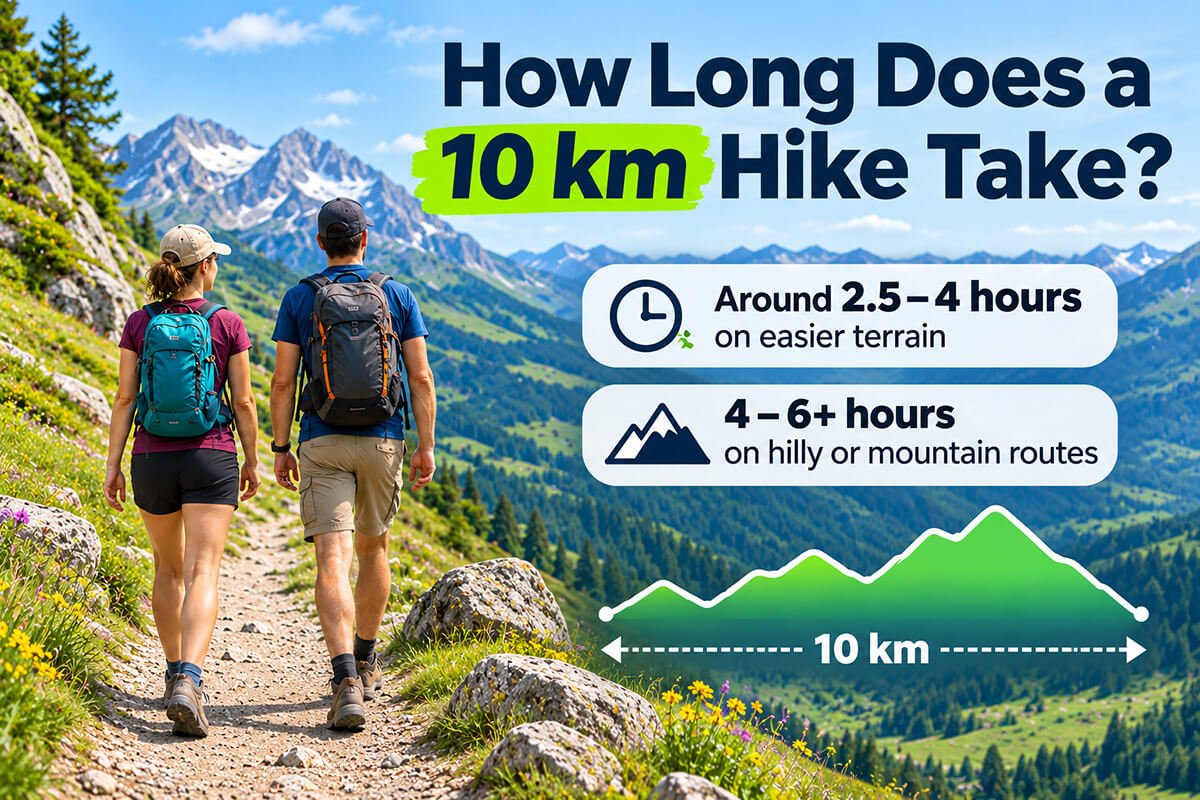
As a general guide, a 10 km hike can take approximately 2.5 – 4 hours on relatively easy terrain, while hilly or mountainous routes may take 4–6 hours or considerably longer.
The biggest factors are your walking speed, elevation gain, trail conditions and how often you stop along the way.
A flat 10 km walk along a well-maintained path is very different from a 10 km mountain hike with 1,000 metres of climbing.
In this guide, we’ll look at how long different types of 10 km hikes might take, how elevation affects hiking speed and how you can plan your route before setting off.
Average Time to Hike 10 km
The easiest way to estimate hiking time is to consider the type of terrain you’ll be walking on.
Here’s a general comparison.
| Hiking terrain | Estimated time for 10 km |
|---|---|
| Flat, easy walking paths | 2 – 3 hours |
| Gentle hills and maintained trails | 3 – 4 hours |
| Hilly terrain with substantial climbing | 4 – 5 hours |
| Steep mountain trails | 5 – 7+ hours |
| Very technical or difficult terrain | 7+ hours possible |
These are broad planning estimates, not guaranteed finishing times. They can vary considerably depending on the route and your experience.
They also don’t include extended lunch breaks, sightseeing stops or long periods of rest.
If you’re planning a mountain hike, it’s always better to allow extra time rather than assuming you’ll maintain the same pace as walking on a flat road.
How Does Walking Speed Affect a 10 km Hike?
Your average walking speed has a significant impact on how long your hike will take.
On relatively flat, easy terrain, some hikers maintain a pace of around 4 – 5 km/h.
Others prefer a more relaxed pace, particularly when carrying a backpack or walking with a group.
Here’s how different speeds affect the time needed to cover 10 km.
| Average walking speed | Time to hike 10 km |
|---|---|
| 2 km/h | 5 hours |
| 2.5 km/h | 4 hours |
| 3 km/h | 3 hours 20 minutes |
| 3.5 km/h | 2 hours 51 minutes |
| 4 km/h | 2 hours 30 minutes |
| 5 km/h | 2 hours |
These calculations assume a steady average speed without breaks.
On mountain trails, your speed may change significantly between uphill, flat and downhill sections.
For example, you might comfortably maintain 4 km/h on a flat path but slow to 2 km/h or less on a steep climb.
That’s why distance alone doesn’t always give you an accurate hiking-time estimate.
How Elevation Gain Affects Hiking Time
Elevation gain is one of the most important things to consider when planning a hike.
It measures the total amount of climbing along your route.
For example:
- A 10 km hike with 100 m of elevation gain is relatively flat.
- A 10 km hike with 300 m of elevation gain includes noticeable climbing.
- A 10 km hike with 600 m of elevation gain may be quite demanding.
- A 10 km hike with 1,000 m of elevation gain involves substantial mountain climbing.
The amount of climbing can change how long the hike takes, even when the total distance stays the same.
Example: 10 km Hike With Different Elevation Gains
One useful method of estimating hiking time is to start with a flat walking speed of approximately 4 km/h and add extra time for climbing.
Using a common hiking-time guideline that adds roughly 15 minutes for every 100 metres of ascent, we get:
| Elevation gain | Estimated time before descent adjustments and breaks |
|---|---|
| 0 m | 2 hours 30 minutes |
| 200 m | 3 hours |
| 400 m | 3 hours 30 minutes |
| 600 m | 4 hours |
| 800 m | 4 hours 30 minutes |
| 1,000 m | 5 hours |
These are simplified estimates based on distance and ascent. Steep or technical descents can add further time.
For a 10 km mountain hike with 1,000 m of climbing, it’s possible to spend much longer on the trail than someone walking the same distance on flat ground.
This is why checking your route’s elevation profile is so important.
Is a 10 km Hike Difficult?
A 10 km hike can be relatively manageable or extremely challenging, depending on the route.
For example, a flat 10 km hike through a nature reserve may be suitable for many people with reasonable walking fitness.
But a 10 km route with steep climbs, exposed mountain paths and loose rocks can be physically demanding.
Before deciding whether a hike is suitable, consider:
Distance: How far will you need to walk?
Elevation gain: How much climbing is involved?
Gradient: Are the climbs gentle or very steep?
Terrain: Will you be walking on smooth paths, loose rocks or uneven mountain trails?
Weather: Could heat, rain, wind or poor visibility affect your hike?
Experience: Are you comfortable with the distance and type of terrain?
Two hikes of the same distance can feel completely different.
A shorter hike with steep climbing may even be more difficult than a much longer walk on easy terrain.
How to Estimate Your Hiking Time
You don’t need complicated calculations to get a useful estimate.
Here’s a straightforward method.
Step 1: Measure the Route Distance
First, work out how far you’ll actually be walking.
Don’t assume that the distance between your starting point and destination is the total hiking distance.
Trails often follow winding paths, switchbacks and uneven terrain.
You can use the Map My Distance Hiking Route Planner to create your route and measure its total distance.
Step 2: Check the Elevation Profile
Next, look at the amount of climbing and descending along the route.
A 10 km hike with 200 m of elevation gain will usually take less time than a similar route with 800 m of climbing.
MMD lets you view an elevation profile to identify where major climbs and descents occur.
This helps you understand whether you’ll be climbing gradually throughout the hike or tackling one particularly steep section.
Step 3: Estimate Your Average Speed
For an easy route, you might use a walking speed of approximately 3–4 km/h as a starting point.
For more demanding trails, use a slower estimate that reflects your experience.
It’s useful to compare the route with hikes you’ve completed previously.
Step 4: Allow Extra Time for Climbing and Descending
Once you’ve calculated your basic walking time, add an allowance for elevation gain.
Remember that downhill sections aren’t always faster.
Steep descents with loose rocks, steps or uneven surfaces can require careful movement and may take longer than expected.
Step 5: Include Breaks and Unexpected Delays
Finally, allow extra time for:
- Rest stops
- Food and water breaks
- Taking photographs
- Navigating unfamiliar trails
- Difficult terrain
- Changes in weather
If your estimated moving time is four hours, you might want to allow five hours or more for the full outing, depending on the route and your plans.
How Long Does a 10 km Mountain Hike Take?
Mountain hikes often take quite a bit longer than your ordinary walks.
Here are examples of two different 10 km routes.
Route A: Easy Nature Reserve Walk
- Distance: 10 km
- Elevation gain: 150 m
- Maintained walking paths
- Mostly gentle gradients
You might complete this route in approximately 2.5–3.5 hours of walking.
Route B: Challenging Mountain Hike
- Distance: 10 km
- Elevation gain: 900 m
- Steep rocky climbs
- Uneven and technical descents
This route could take five hours or longer, depending on your fitness, experience and trail conditions.
Although both routes cover 10 km, the amount of effort and time required can be completely different.
That’s why it’s important to study both distance and elevation before heading into the mountains.
Plan Your 10 km Hiking Route With Map My Distance
One of the easiest ways to prepare for a hike is to map the route before leaving home.
With Map My Distance, you can create hiking routes online for free, measure distances and view elevation profiles to help you understand what lies ahead.
You can use MMD to:
- Create a hiking route directly on an interactive map
- Measure the total hiking distance
- Check the route elevation profile
- Identify major climbs and descents
- Adjust the route before setting off
- Save your favourite hiking routes
- Share planned routes with friends or hiking groups
Whether you’re planning a 5 km nature walk, a 10 km mountain hike or a longer outdoor adventure, MMD makes it easy to explore different route options.
Free users can start planning without paying and save routes within the Free account limits.
MMD Pro also offers advanced elevation statistics and GPX exports for use with compatible GPS devices and navigation applications.
How Much Time Should You Allow for Breaks?
When estimating hiking time, it’s easy to focus only on how long you’ll spend walking.
But breaks are part of the experience.
You might stop to enjoy a viewpoint, have lunch, take photographs or simply rest after a difficult climb.
A practical starting point is to allow an additional 5 – 10 minutes per hour of hiking, plus any longer planned stops.
For example:
| Activity | Time |
|---|---|
| Estimated hiking time | 3 hours 30 minutes |
| Short rest and water breaks | 30 minutes |
| Lunch or extended viewpoint stop | 30 minutes |
| Total planned outing | 4 hours 30 minutes |
The amount of additional time you need will depend on your group and the route.
If you’re hiking with children, inexperienced hikers or a large group, consider allowing more time.
Can Beginners Complete a 10 km Hike?
Yes, some beginners can comfortably complete a 10 km hike, particularly on easy, well-maintained terrain.
However, beginners shouldn’t judge a hike by distance alone.
If you’re new to hiking, it’s sensible to start with shorter routes and gradually increase your distance and elevation.
A 5 km route with gentle hills may be a useful starting point before attempting longer mountain hikes.
You should also consider footwear, water, weather, daylight and the availability of suitable routes.
For more demanding hikes, make sure to check local trail information or consider going with experienced companions.
A route that is manageable for one beginner might be too difficult for another.
Tips for Planning a Safe 10 km Hike
Make sure to do a little preparation before hiking, this can make a big difference to your experience.
Before going on your hike, we recommend:
- Checking the weather forecast and trail conditions
- Understanding the route distance and elevation
- Making sure the trail is open and accessible
- Carrying enough water and suitable food
- Wearing footwear appropriate for the terrain
- Allowing enough daylight to finish comfortably
- Telling someone where you’re going
- Carrying appropriate navigation and emergency equipment
- Having a backup plan if conditions change
Remember that an online route planner is a useful preparation tool, but it doesn’t replace local knowledge or navigation equipment.
Mapped paths may be closed, unsafe or different from what appears on the screen.
Always make sure of your planned route before heading out.
Is Hiking 10 km the Same as Walking 10 km?
It’s not always the same.
A 10 km walk along flat roads or paved paths may take approximately 2–3 hours.
A 10 km mountain hike might take four, five or even more hours because of climbing and technical terrain.
Hiking often involves additional challenges such as uneven surfaces, steep gradients, loose rocks and more demanding navigation.
The distance is the same, but the experience can be quite different, mainly because of the terrain.
This is why estimated walking times shouldn’t automatically be used for difficult hiking routes.
Final Thoughts: How Long Should You Plan for a 10 km Hike?
For an easy 10 km hike, allowing approximately 2.5 – 4 hours of walking is a reasonable starting point.
For hilly or mountainous routes, you may need 4 – 6 hours or considerably longer.
The biggest factors are your walking speed, elevation gain, terrain difficulty and how much time you spend resting.
The best way to estimate your hiking time is to look at distance and elevation together.
Before your next hike, use Map My Distance to measure your planned route and check its elevation profile.
That way, you’ll have a better understanding of what to expect before stepping onto the trail.