
Packing for a trail running race can feel surprisingly stressful, especially if it is your first event or you are travelling somewhere unfamiliar.
Unlike a normal road race, trail events can involve steep climbs, technical terrain, remote sections, sudden weather changes and long periods between aid stations.
That means your packing list needs to cover more than just shoes, shorts and a race bib.
We recommend getting everything ready well before race morning so that you can focus on the race itself rather than wondering whether you forgot something important.
This trail running race checklist covers the essentials we would think about before heading to the start line.
You can also use Map My Distance to plan recce routes, calculate the pace you want to try stick to and more.
Start by Checking the Race Requirements
Before packing anything, check the event’s official race information.
Many trail races have a compulsory equipment list, particularly longer or more remote events.
This might include items such as:
- Waterproof jacket
- Emergency blanket
- Headlamp
- Whistle
- Water capacity
- Mobile phone
- Warm clothing
- First-aid supplies
- Cup or reusable container
- Specific food requirements
Do not assume that the kit required at your previous race will be the same for the next one.
Race organisers may perform gear checks before the start or during the event, and missing a compulsory item could prevent you from racing.
We suggest making the official mandatory gear list the first section of your packing checklist.
Study the Route Before You Pack
The course itself should also influence what you take with you.
Look at:
- Total distance
- Elevation gain
- Highest point
- Long climbs
- Technical sections
- Aid station locations
- Water availability
- Expected race duration
A 20 km trail race with 1,500 metres of climbing is very different from a flatter 20 km event.
If the course takes you into exposed or mountainous areas, you may need more protection from wind, rain or cold than you would expect from the temperature at the start line.
We also recommend checking the route and elevation profile before race day so you know roughly where the difficult sections are.
If the event route is available online, take some time to study it rather than seeing the course for the first time during the race., even start planning recce routes before you run the actual route.
Trail Running Shoes
Your shoes are probably the most important item on the list.
Choose trail shoes that are suitable for the terrain and, ideally, shoes you have already trained in.
Race day is usually not the best time to test a brand-new pair.
Think about:
- Grip
- Cushioning
- Trail surface
- Distance
- Weather
- Drainage
- Comfort
For muddy or loose terrain, stronger grip may be important.
For longer races, comfort may matter more than saving a small amount of weight.
We suggest checking your shoes a few days before the race for worn tread, damaged laces or anything else that could cause trouble.
Running Clothes
What you wear will depend heavily on the weather and location.
Your basic clothing might include:
- Running shorts or tights
- Technical running shirt
- Sports bra if required
- Running socks
- Hat or cap
- Sunglasses
Avoid racing in clothing you have never worn before.
Something that feels fine for ten minutes at home can cause chafing after three hours on the trail.
If you know certain clothing combinations work well during your long training runs, race day is a good time to stick with them.
Waterproof and Warm Layers
Even if the weather looks good at the start, conditions can change quickly in the mountains.
Depending on the race, we would consider packing:
- Waterproof jacket
- Windbreaker
- Long-sleeve thermal layer
- Gloves
- Beanie or warm hat
Longer races may require some of these items as mandatory gear.
Do not pack purely for how warm it feels in the race village. Conditions at higher elevation can be completely different.
Hydration Vest or Running Pack
For many trail races, a hydration vest is one of the easiest ways to carry everything comfortably.
Make sure it fits properly and that you have trained with it before race day.
Your vest may need to carry:
- Water
- Food
- Jacket
- Phone
- Emergency equipment
- Headlamp
- Spare clothing
We recommend packing it the night before and then wearing it briefly around your room.
It sounds simple, but this can quickly tell you if something is bouncing around, digging into your back or sitting in the wrong pocket.
Water and Hydration
Check how far apart the aid stations are.
Some races provide water frequently, while others may have long unsupported sections.
Make sure you have enough carrying capacity for the longest section between water points.
Common options include:
- Soft flasks
- Hydration bladder
- Handheld bottle
If you use electrolyte tablets or drink mix during training, bring the same products to the race.
Race day is not the ideal time to experiment with a new hydration strategy.
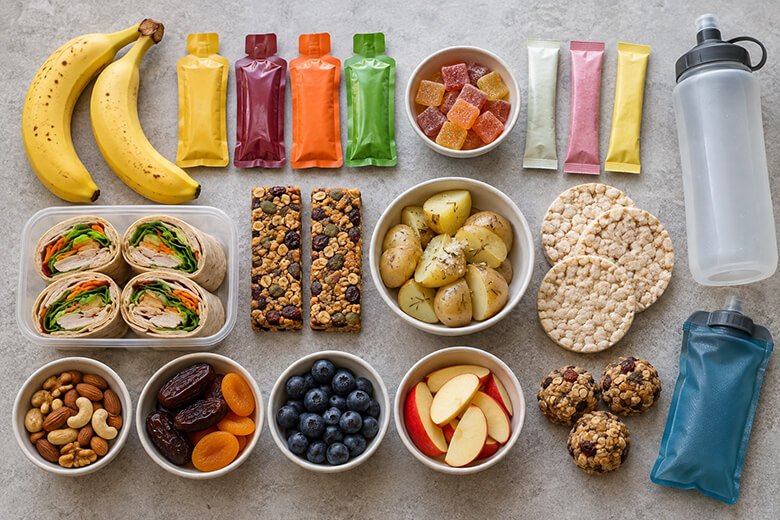
Race Nutrition
Pack food that you already know works for you.
Depending on the distance, this might include:
- Energy gels
- Chews
- Energy bars
- Bananas
- Sandwiches
- Potatoes
- Electrolyte drinks
- Other simple foods you have used in training
Long trail races can make sweet food difficult to tolerate after several hours, so some runners like to carry a mixture of sweet and savoury options.
It is usually better to carry a little more than you think you need than to run out before reaching the next aid station.
Safety Gear You Should Consider Carrying
Safety should be part of your race preparation, even when the event is well organised.
Your exact requirements will depend on the race, but useful safety items can include:
- Fully charged mobile phone
- Emergency blanket
- Whistle
- Small first-aid kit
- Waterproof jacket
- Headlamp
- Spare headlamp battery
- Basic pain-free blister supplies
- Identification
- Emergency contact details
We strongly suggest saving the race emergency number on your phone before you start.
It is also worth telling someone where you are running, particularly on longer or more remote events.
Even during organised races, runners can take a wrong turn or become separated from the main field.
Headlamp
If there is any possibility of running in darkness, carry a reliable headlamp.
Check the battery beforehand and pack spare power if necessary.
Do not wait until race morning to discover that the headlamp has not been charged since your last night run.
For long ultras, some runners also carry a second small light as a backup.
Your Mobile Phone
Charge your phone fully the night before.
Depending on the race, your phone may be useful for:
- Emergency calls
- Route information
- Race messages
- Tracking
- Weather updates
- Contacting your support crew
Consider enabling battery-saving mode if you expect to be out for many hours.
A small waterproof bag can also help protect it from rain and sweat.
GPS Watch
If you use a GPS watch, charge it fully.
For longer races, check whether the battery will last for your estimated race time.
Some watches have different GPS or battery modes that can extend battery life.
Make sure you understand how these work before the race rather than changing unfamiliar settings at the start line.
Put Your Race Bib on the Night Before
This is one of those small tips we suggest that can make race morning much easier.
We suggest attaching your bib to your shirt, race belt or whatever you plan to wear the night before the race.
Check that:
- The number is visible
- It is the right way up
- It does not cover important pockets
- It will not interfere with your hydration vest
- Any timing chip is attached correctly
Doing this the night before means one less job when you are half awake at 5am.
If the race uses a separate timing chip, put that with your shoes or other race equipment so you cannot forget it.
Lay Everything Out the Night Before
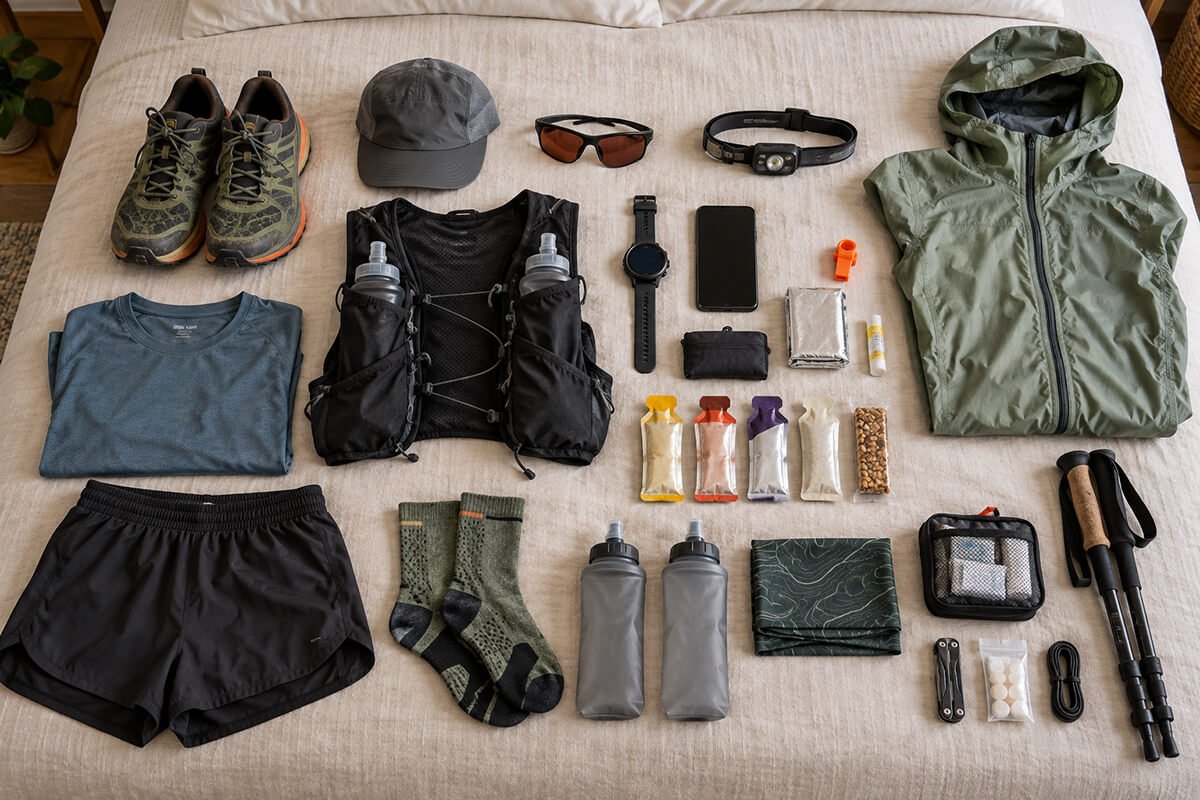
Rather than leaving everything inside different bags, lay your race kit out where you can see it.
A simple setup might be:
Clothing
Shirt, shorts, socks, hat.
Shoes
Shoes with timing chip if applicable.
Race gear
Vest, bib, mandatory kit.
Nutrition
Gels, bars, drink mix.
Electronics
Watch, phone, headlamp.
Other
Sunscreen, anti-chafe and decent sunglasses.
We find this much easier than trying to remember everything individually the next morning.
Sunscreen and Anti-Chafe
These two small items can make a big difference.
Apply sunscreen before the start, especially on exposed races.
For longer runs, consider carrying a small refills of these creams to reapply later.
Anti-chafe cream can also be useful around areas such as:
- Underarms
- Thighs
- Waistband
- Feet
- Hydration vest contact points
Use products you have tested before.
Blister Prevention
If you regularly get blisters, deal with known problem areas before the race.
This might involve:
- Good running socks
- Lubricant
- Taping
- Blister patches
- Correctly fitted shoes
Carrying a small kit for preventing blistering can also be useful on longer events.
Stopping for two minutes to deal with a hot spot can be much better than ignoring it for another 30 km.
Post-Race Clothing
One thing runners often forget is what they are going to wear after the race. Your running top will be soaking wet and might get cold after the race.
Pack a separate bag containing:
- Dry shirt
- Warm top
- Dry socks
- Comfortable shoes or sandals
- Jacket
- Towel if needed
Even on a warm day, you can cool down quickly once you stop running.
Being able to change into dry clothes after finishing can make a huge difference.
Food and Drink for After the Race
The event may provide food, but we still like having something familiar available.
Consider leaving:
- Water
- Recovery drink
- Snack
- Favourite food
in your post-race bag or vehicle.
After a hard race, the food you thought you would want beforehand may not be appealing, so having a couple of options can help.
Check the Weather Again
Check the forecast a few days before the race and again the night before.
Pay attention to more than just temperature.
Look at:
- Rain
- Wind
- Humidity
- Temperature changes
- Conditions at higher elevations
The weather at the start area may not reflect what you experience later in the race.
Do Not Try Too Many New Things on Race Day
This applies to almost everything:
- Shoes
- Socks
- Food
- Hydration products
- Clothing
- Backpack
- Poles
- Watch settings
We suggest using race day equipment during training first whenever possible.
The more familiar your equipment is, the fewer surprises you are likely to have during the race.
A Simple Trail Race Packing Checklist
Before leaving for the race, check that you have:
- Trail running shoes
- Running socks
- Shorts or tights
- Running shirt
- Hydration vest
- Water bottles or soft flasks
- Race nutrition
- Waterproof jacket
- Warm layer if needed, for longer runs
- Hat
- Sunglasses
- Sunscreen
- Anti-chafe
- Mobile phone
- GPS watch
- Headlamp if required
- Emergency blanket
- Whistle
- First-aid basics
- Mandatory race equipment
- Race bib
- Post-race clothing
- Dry shoes
- Food and water for afterwards
And most importantly, check the organiser’s mandatory gear list one more time.
Final Trail Race Preparation Tips
Packing properly will not make the race easy, but it can remove a lot of unnecessary stress.
Our preference is to have almost everything finished the night before.
Attach your bib.
Charge your watch and phone.
Pack your hydration vest.
Prepare your nutrition.
Lay out your clothes.
Check the route and weather.
Then race morning becomes much simpler.
You can wake up, eat, get dressed and focus on enjoying the event rather than searching through your bag for something you forgot.
Trail running often involves uncertainty, and that is part of what makes it exciting. Good preparation simply means you are better equipped to deal with whatever the course gives you.
Map My Distance can also be used as:
Walking Route Planner
Hiking Route Planner
Cycling Route Planner