
If you’ve ever planned a running route, tackled a steep hiking trail or cycled up a mountain road, you’ve probably come across gradient percentages.
You might see a hill described as having a 5%, 10% or even 20% gradient.
But what do those numbers actually mean? And how steep is a 10% gradient compared with a 5% or 20% climb?
A 5% gradient is a noticeable incline, 10% is a steep climb, and 20% is extremely steep for most runners, hikers and cyclists.
Gradient percentages describe how quickly the ground rises or falls over a horizontal distance.
Understanding them can help you choose suitable routes, prepare for difficult climbs and avoid unexpected hills.
In this guide, we’ll explain gradient percentages, compare different levels of steepness and show how gradient affects running, hiking and cycling.
What Does Gradient Percentage Mean?
Gradient percentage is a way of measuring how steep a hill or slope is.
It compares the vertical height gained with the horizontal distance travelled.
For example:
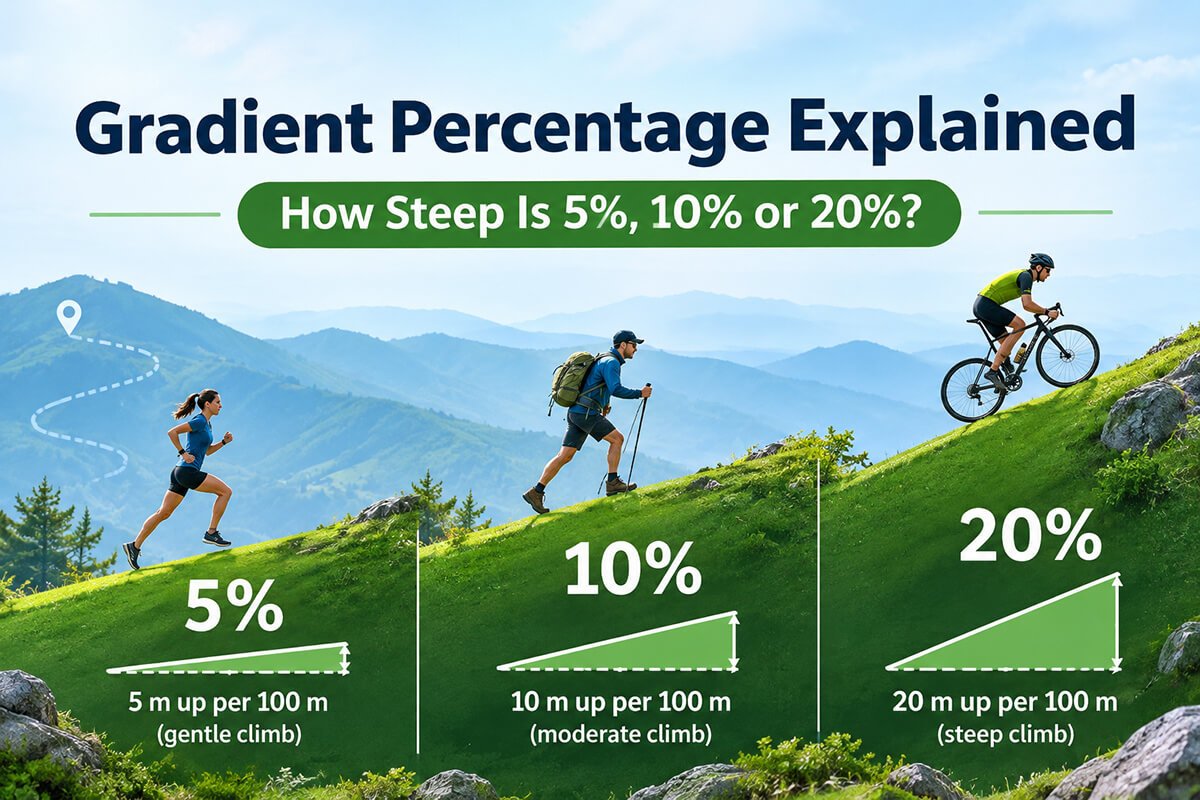
- 5% gradient: The ground rises 5 metres for every 100 metres of horizontal distance.
- 10% gradient: The ground rises 10 metres for every 100 metres of horizontal distance.
- 20% gradient: The ground rises 20 metres for every 100 metres of horizontal distance.
The higher the percentage, the steeper the hill.
This is why a 20% gradient can feel dramatically harder than a 5% gradient, even if you’re covering the same distance.
Gradient can also be negative. A -10% gradient describes a downhill slope that drops 10 metres for every 100 metres of horizontal distance.
Gradient Percentage Chart: How Steep Is Each Gradient?
Here’s a quick comparison of common gradient percentages.
| Gradient | Height gained over 100 m horizontally | Approx. angle | General description |
|---|---|---|---|
| 1% | 1 m | 0.6° | Very gentle incline |
| 3% | 3 m | 1.7° | Gentle hill |
| 5% | 5 m | 2.9° | Noticeable climb |
| 8% | 8 m | 4.6° | Moderately steep |
| 10% | 10 m | 5.7° | Steep climb |
| 12% | 12 m | 6.8° | Very steep |
| 15% | 15 m | 8.5° | Challenging climb |
| 20% | 20 m | 11.3° | Extremely steep |
| 25% | 25 m | 14.0° | Exceptionally steep |
These descriptions are general guides rather than official difficulty ratings.
How difficult a gradient feels depends on the activity, terrain, fitness and length of the climb.
A short 15% incline may be manageable, while a continuous 10% climb lasting several kilometres can be exhausting.
How Steep Is a 5% Gradient?
A 5% gradient means you climb 5 metres for every 100 metres of horizontal distance.
This is a noticeable uphill slope, but it may still feel relatively manageable for many walkers, runners and cyclists.
For example, a continuous 5% climb over 1 km of horizontal distance would gain approximately 50 metres of elevation.
What does a 5% gradient feel like?
Running: You’ll probably notice your breathing becoming heavier and your pace slowing compared with flat ground.
Hiking: It generally feels like a gradual uphill walk, although a long climb can still become tiring.
Cycling: A 5% incline is a meaningful climb, particularly if it continues for several kilometres.
For many outdoor activities, a 5% gradient is a good example of a hill that requires extra effort without necessarily being extremely difficult.
How Steep Is a 10% Gradient?
A 10% gradient means the ground rises 10 metres for every 100 metres of horizontal distance.
This is considered a steep incline for most recreational outdoor activities.
To put it into perspective, a continuous 10% climb over 1 km horizontally would gain approximately 100 metres of elevation.
That’s twice the elevation gain of a 5% gradient over the same distance.
What does a 10% gradient feel like?
Running: Maintaining your normal flat-road running pace becomes much harder. Depending on the length and terrain, you might naturally slow to a jog or power hike.
Hiking: A 10% gradient is a noticeable uphill climb that requires more effort, particularly when carrying a backpack.
Cycling: A sustained 10% climb can be demanding, even for experienced cyclists. Gearing, fitness and the length of the climb make a big difference.
A 10% gradient might not look particularly dramatic on a map, but it can feel surprisingly steep when you’re actually climbing it.
How Steep Is a 20% Gradient?
A 20% gradient means the ground rises 20 metres for every 100 metres of horizontal distance.
This is an extremely steep slope for most runners, hikers and cyclists.
A continuous 20% gradient over 1 km horizontally would gain approximately 200 metres of elevation.
That’s a significant amount of climbing over a relatively short distance.
What does a 20% gradient feel like?
Running: Many runners will find it more efficient to power hike rather than attempt to run continuously.
Hiking: This is a very steep climb that can require careful footing, especially on rocky or loose terrain.
Cycling: A sustained 20% incline is extremely demanding. Many recreational cyclists may struggle to maintain momentum, even with suitable low gearing.
The length of the climb is especially important.
A short 20% ramp might last only a few seconds, but a sustained climb at that gradient can be a serious physical challenge.
Is a 10% Gradient the Same as 10 Degrees?
No. This is one of the most common misunderstandings about hill gradients.
A gradient percentage measures the ratio between vertical rise and horizontal distance.
Degrees measure the actual angle of the slope.
For example:
| Gradient percentage | Approximate angle |
|---|---|
| 5% | 2.86° |
| 10% | 5.71° |
| 15% | 8.53° |
| 20% | 11.31° |
| 50% | 26.57° |
| 100% | 45° |
A 100% gradient is therefore a 45-degree slope, not a vertical wall.
A truly vertical slope approaches 90 degrees, with an unbounded percentage gradient.
For a more detailed explanation of how gradient percentages and slope angles are calculated, see the U.S. Geological Survey’s guide to calculating slope.
How to Calculate Gradient Percentage
If you know the elevation gained and the horizontal distance covered, you can calculate the gradient using a simple formula.
Gradient (%) = (Elevation Gain ÷ Horizontal Distance) × 100
For example, imagine a hill that rises 80 metres over a horizontal distance of 1,000 metres.
The calculation would be:
(80 ÷ 1,000) × 100 = 8% gradient
That hill has an average gradient of 8%.
Another example: 150 metres of climbing over 1 km
If you climb 150 metres over 1,000 metres horizontally:
(150 ÷ 1,000) × 100 = 15% gradient
That would be a very steep average climb.
When calculating gradient, the horizontal distance and elevation gain must use the same units.
Also remember that the distance shown on a GPS watch or route planner may be the distance along the slope rather than the exact horizontal distance. For ordinary outdoor planning, the difference is often small on gentle slopes, but it becomes more important on very steep terrain.
Gradient vs Elevation Gain: What’s the Difference?
Gradient and elevation gain are related, but they measure different things.
Elevation gain describes how much climbing you’ve completed in total.
Gradient describes how steep a particular section of the route is.
For example, consider two routes:
Route A:
- Distance: 10 km
- Elevation gain: 500 m
- Climbing spread across several gentle hills
Route B:
- Distance: 10 km
- Elevation gain: 500 m
- Most of the climbing concentrated into one steep section
Both routes have the same total elevation gain, but Route B could feel considerably harder during the steep climb.
This is why it’s useful to consider gradient and elevation gain together.
If you’re interested in how climbing affects trail running difficulty, read our guide to How Much Elevation Gain Is a Lot for Trail Running?.
How Gradient Affects Running
For runners, gradients can have a major impact on pace and effort.
Running uphill requires additional energy to overcome gravity, which is why your pace typically slows as the gradient increases.
A relatively gentle incline might allow you to maintain a steady running rhythm.
However, once the gradient becomes steep, your running form and effort can change significantly.
Running on different gradients
- 1 – 3%: Gentle incline that may only slightly affect pace.
- 5%: Noticeable hill requiring additional effort.
- 8 – 10%: Steep running climb where pace may slow considerably.
- 15%: Very demanding uphill running.
- 20% or more: Power hiking may be more practical, especially on trails.
These are general descriptions. Experienced hill runners may handle steeper gradients differently.
When planning a training route or trail race, it’s useful to know not just how much climbing is involved, but where the steep sections are located.
Use the MMD Running Route Planner to measure your route and review its elevation profile before heading out.
How Gradient Affects Hiking
Gradient is equally important when planning a hiking route.
A hiking trail with a gentle incline may be suitable for a relaxed walk, while a route with steep climbs can become physically demanding.
On hiking trails, terrain also matters.
A 15% gradient on a smooth, maintained path can feel very different from the same gradient on loose rocks, slippery ground or uneven steps.
Steep descents can also be challenging, especially when carrying a heavy backpack.
When planning a hike, consider:
- Total hiking distance
- Total elevation gain
- Steepness of major climbs
- Technical difficulty of the terrain
- Time needed for climbing and descending
- Weather and trail conditions
You can use the MMD Hiking Route Planner to measure a route and view its elevation profile.
If you’re trying to estimate how long your planned hike might take, also read our guide on How Long Does a 10 km Hike Take?
How Gradient Affects Cycling
Cyclists often pay close attention to gradient percentages because even small changes in steepness can significantly affect climbing effort.
For example, a 3% incline might feel manageable on a road bike, while a sustained 10% climb can become challenging.
At 15–20%, gearing, traction and the cyclist’s fitness become increasingly important.
What counts as a steep cycling climb?
| Gradient | General cycling difficulty |
|---|---|
| 1 – 3% | Gentle incline |
| 4 – 6% | Moderate climb |
| 7 – 9% | Challenging climb |
| 10 – 12% | Steep climb |
| 13 – 15% | Very steep |
| 16 – 20%+ | Extremely demanding |
These classifications are approximate. A short hill and a climb lasting several kilometres can feel very different, even at the same gradient.
When planning a cycling route, it’s useful to review the elevation profile so you can anticipate the major climbs.
Try the MMD Cycling Route Planner to create routes, measure distances and check elevation before your next ride.
How to Check the Elevation of Your Planned Route
You don’t need to know every gradient percentage beforehand to prepare for a hilly route.
With Map My Distance, you can create a route online and view its elevation profile to understand where the major climbs and descents occur.
Here’s how:
- Open the Map My Distance Route Planner.
- Search for your starting location.
- Draw your running, hiking or cycling route on the map.
- Check the total route distance.
- Review the elevation profile to identify climbs and descents.
- Adjust your route if you want to avoid or include challenging hills.
MMD Pro also provides advanced elevation insights, including more detailed gradient information, for users who want to analyse their routes further.
Whether you’re preparing for a trail race, mountain hike or cycling event, checking the elevation before setting off can help you plan more effectively.
Why the Length of a Hill Matters as Much as Its Gradient
One important thing to remember is that gradient percentage alone doesn’t tell you how difficult a climb will be.
Consider two hills.
Hill A:
- Average gradient: 20%
- Horizontal distance: 100 m
- Elevation gain: 20 m
Hill B:
- Average gradient: 10%
- Horizontal distance: 2 km
- Elevation gain: 200 m
Hill A is much steeper, but Hill B involves substantially more total climbing.
Depending on your fitness and activity, the longer climb might be more tiring overall.
This is particularly important for runners and cyclists who need to manage their effort over longer distances.
Instead of focusing only on the steepest gradient, consider the complete elevation profile of the route.
Final Thoughts: How Steep Is 5%, 10% or 20%?
Understanding gradient percentages can make it easier to prepare for running, hiking and cycling routes.
As a general guide:
- 5% gradient: A noticeable but often manageable climb.
- 10% gradient: A steep incline that requires significant effort.
- 15% gradient: A very demanding climb, particularly over longer distances.
- 20% gradient: An extremely steep slope for most recreational outdoor activities.
However, gradient is only part of the picture.
The total distance, elevation gain, terrain and length of the climb all affect how difficult a route will feel.
Before your next adventure, use Map My Distance to plan your route, measure the distance and check its elevation profile.
That way, you’ll have a better understanding of the hills ahead before setting off.